

Written by Mo Kahn on
October 7, 2026


You've probably seen the format while scrolling: a familiar face appears in an ordinary selfie, the image flashes, and the next frame shows a polished feminine version with new hair, clothing, makeup, and lighting. The first reaction is usually, “What would I look like as a girl?” The better question comes afterward: does this image still feel like me, and am I comfortable with where it may travel?
A convincing transformation needs more than a feminine filter. Your reference photo, prompt language, editing choices, consent decisions, and publishing format all shape the result. The strongest workflow treats AI as a creative collaborator, not an identity machine.
You're halfway through a feed when a transformation catches your eye. The face looks familiar enough to invite recognition, but the styling changes the entire impression. A different haircut, softer expression, dress, and pose turn a casual selfie into a character reveal. That combination works because audiences already understand the story structure: there is a “before,” an altered “after,” and an implied shift in how the person moves through the world.
This idea predates AI filters. Historical research traces public discussion of sex transformation to at least the 1930s, when newspapers and magazines in the United States and Europe reported on “sex reversals.” Public attention intensified in the 1950s after Christine Jorgensen became the first widely famous American associated with gender-affirming surgery, making transformation a recurring subject of mass-media coverage. A study of 545 transformation-media narratives found that more than 92 percent depicted male characters becoming female, while only 28 narratives depicted the reverse direction according to the historical transformation-media research.
Those stories often changed more than a character's face. More than 56% of longer narratives also changed the protagonist's social position, which shows why a gender-swap image can feel like a lifestyle or identity transformation rather than a cosmetic edit. That history can inform your creative direction, but it shouldn't be mistaken for a direct representation of transgender people or lived gender identity. Much of the older fictional corpus involved heterosexual cisgender men transformed against their will.
The useful takeaway is simple. Treat the prompt as a starting point for intentional self-representation. You can explore feminine fashion, an alternate character, a visual joke, or a personal idea without allowing the model to decide what femininity must look like.
Start with a reference selfie that gives the model clean information. Face the camera or turn only slightly, use even natural light, and keep hair away from features you want preserved. A heavy filter, deep shadow, dramatic sunglasses, or an extreme angle makes likeness harder to maintain because the image gives the editor less reliable structure.
Upload the photo, enter a direct first prompt, and generate a draft before adding too many artistic instructions. A useful starting point is:
Create a feminine version of this person while preserving facial structure, eye shape, skin tone, expression, and recognizable likeness. Use natural styling, realistic proportions, and age-appropriate clothing.
The point of the first pass is diagnosis. Check whether the tool preserved your eyes, jaw, nose, smile, and overall face shape. If it changed everything at once, don't compensate by writing a huge paragraph. Change one variable, such as hairstyle or clothing, then compare the next result with the original.
Use the Edit tool to refine a promising draft instead of restarting from scratch. Ask for a specific adjustment, such as shoulder-length textured hair, a fitted blazer, subtle makeup, or a different background. Save variations as you work, and record the prompt wording that produced the most recognizable face. This small habit turns random experimentation into a repeatable process.
For creators moving from still images into short-form storytelling, the AIMVG guide to AI music videos offers useful context on building a broader visual sequence. For a separate reference-photo workflow, see how to create an AI image of yourself.
A generic prompt often produces a generic woman. Add only “make me a girl,” and the model may supply its own assumptions about age, body shape, hair, clothing, attractiveness, and pose. The result can be technically polished while looking like a stranger.
A 2025 University of Toronto study found that generated female bodies were more likely to be young, White, blond, facially attractive, and shown in revealing clothing, while visible disabilities and broad age diversity were absent as reported in the study coverage. That finding gives you a practical reason to write beyond gender. If you leave the details blank, the system may fill them with a narrow template.
Use identity details first, then presentation, then creative direction:
The strongest prompts don't treat femininity as one uniform aesthetic. “Feminine” might mean a shaved head and leather jacket, a modest knit outfit, a glamorous evening look, a sporty silhouette, or something deliberately ambiguous. Include cultural styling, hair texture, age, modesty, and body shape when those details protect the person you're trying to depict.
A useful test is to place the original and generated image side by side and ask three questions:
| Check | Weak result | Better direction |
|---|---|---|
| Likeness | New face with familiar pose | Preserve facial landmarks and expression |
| Styling | Young, glossy, revealing default | Name clothing, age, texture, and mood |
| Meaning | “Female” as the entire concept | Define the character's setting and presentation |
Use the prompt engineering guide for beginners when you want to expand this layered approach. The goal isn't to describe every pixel. It's to tell the model which decisions belong to you and which can remain flexible.
A transformation becomes ethically complicated the moment the face belongs to someone else. Don't upload a friend's selfie, a colleague's headshot, or a public figure's image for a gender-swap without clear permission. A playful intention doesn't remove the other person's right to control how their likeness is altered or circulated.
Public tutorials often focus on the prompt and the final filter, even though people may transform selfies, publish the results, or use the exercise while exploring gender identity. Research on this context emphasizes the need for consent and privacy guidance, not just visual instructions in the discussion of public-facing AI image transformations.
Before generating, define the use case. A private experiment has a different risk profile from a public post, book character, advertisement, or merchandise design. You should also check whether the final image still resembles you closely enough to create confusion.
Avoid framing the output as a factual statement about someone's gender. “This is a feminine character concept based on my selfie” is more responsible than presenting an altered image as proof of another person's identity. Also review the image for accidental sexualization, misleading uniforms, occupational stereotypes, or cultural details the model has invented.
The same principle applies to face-swap workflows. The face-swapping guide is useful for understanding the creative technique, but the permission decision comes first. Responsible boundaries don't weaken the content. They make it easier to explain, share, and defend.
A polished image can still disappear in a crowded feed if the format gives viewers no reason to stop. Compare a static portrait with a short reveal sequence. The portrait gives the audience time to inspect details, while the video can build anticipation with an original selfie, a transition, and the final transformation. Neither format is automatically better. The right choice depends on whether your strength is visual detail or timed storytelling.
For a fashion account, try a consistent outfit palette and a close portrait crop. For a gaming account, carry the same facial features into a character costume and environment. For an author, make the transformation part of a character introduction rather than a disconnected beauty edit. The prompt should serve the niche, not merely reproduce a popular face.
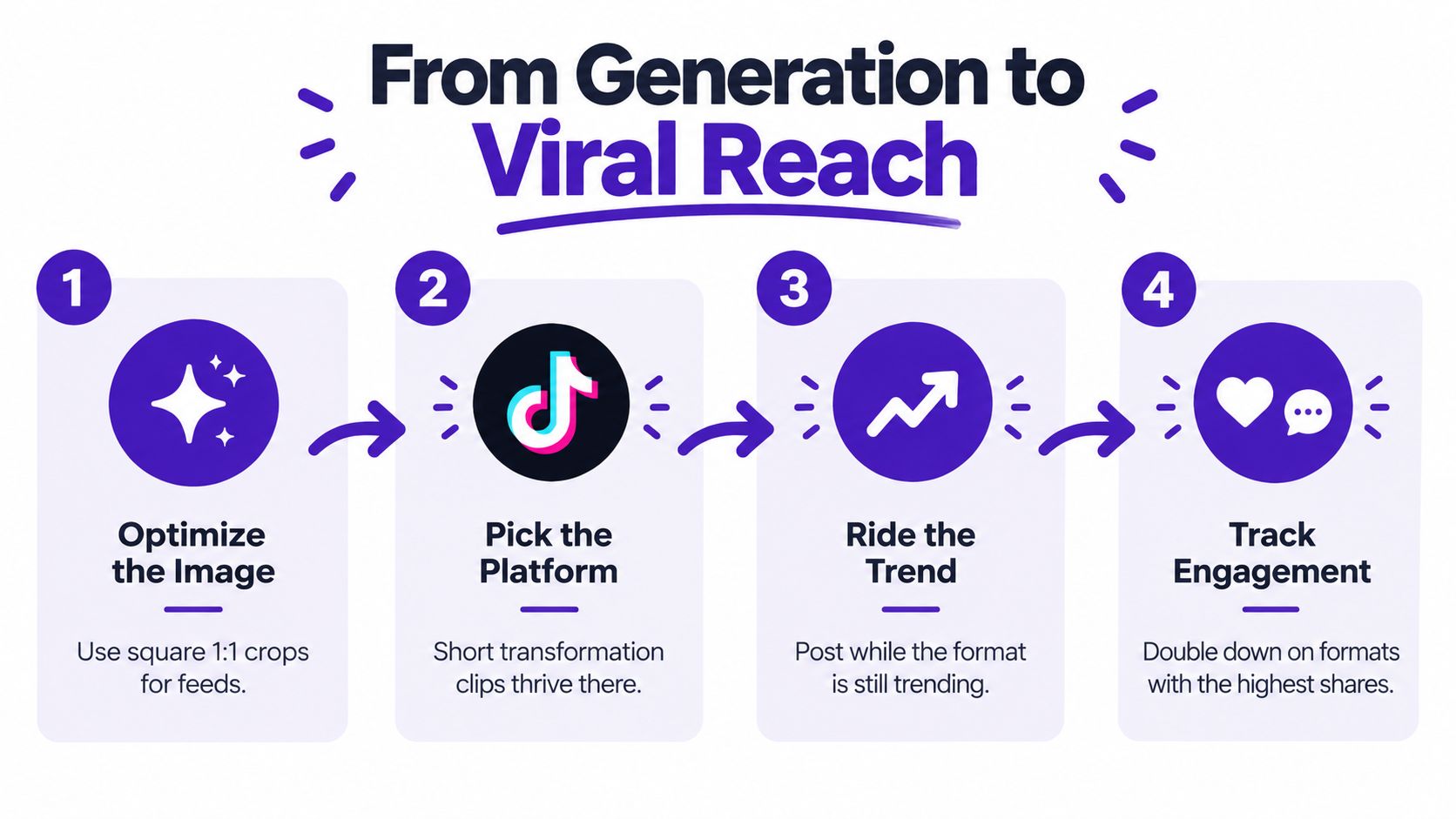
TikTok's For You feed uses three categories of signals: user interactions, content information, and user information. Interactions include likes, shares, comments, full watches, skips, and follows. Content information includes sounds, hashtags, view counts, and the country where a video was published in TikTok's explanation of recommendation signals.
TikTok also says recommendations can reflect whether viewers comment, like, share, or watch similar posts, whether content is popular in their country, whether it's recent, and whether they tend to enjoy longer videos. The relative importance of these factors can change, so no hashtag guarantees reach in TikTok's guidance on the For You feed.
For commercial work, don't assume that entering a prompt makes the entire output exclusively yours. The U.S. Copyright Office's guidance on copyright and generative AI says protection can apply when a human author determines sufficient expressive elements, while prompts alone aren't enough. Your arrangement, edits, typography, illustration, retouching, and overall composition may matter when you turn a transformation into a book cover, print, or product design.
The fastest route to a forgettable image is to accept the first feminine output. It may have smooth skin, fashionable clothes, and attractive lighting, but those qualities don't make it personal. A stronger result comes from preserving the features that identify you, specifying the details the model tends to stereotype, and iterating toward a presentation you'd genuinely choose.
Before publishing, check the face, body, clothing, age, cultural styling, and emotional tone. Confirm that you have permission for every person depicted. Decide whether the image is private experimentation, a labeled AI post, a fictional character, or commercial artwork. Then select the crop, transition, sound, and caption based on the audience rather than chasing a trend that doesn't fit.
The phrase “make me a girl” can describe a playful visual prompt, but the finished image carries more meaning than the wording suggests. It can become a fashion experiment, a character study, a social post, or a personal exploration. Intentional iteration beats instant generation because it gives you control over both the image and the story attached to it.
starryai turns selfies, text prompts, and emojis into AI-generated visuals, and its Edit tool can help you explore feminine styling while refining a reference image. Visit starryai to create a controlled gender-swap concept, test authentic variations, and choose what you're ready to share.


.svg)