

Written by Mo Kahn on


You open TikTok for a quick break and find the same satisfying reveal waiting on your For You page: an old school photo, a beat drop, then a polished present-day portrait with different hair, clothes, lighting, and energy. The comments ask the same questions every time: “What did you do?” “How do I glow up?” “Is that really the same person?”
That format is easy to recognize, but its meaning is broader than a makeover. A glow up is a visual language for showing change. You can use it to explore style, confidence, a fictional character, a new career identity, or an entire fantasy world. With the right creative choices, starryai can help you remix that language into a self-directed identity instead of copying one narrow idea of beauty.
A TikTok creator scrolls through her feed and notices a pattern. One post begins with a childhood image. Another starts with a tired mirror selfie. A third shows an old outfit beside a dramatic new look. Then the audio rises, the frame changes, and each creator presents a version of personal progress in a single reveal.
TikTok and Instagram made this format especially easy to repeat. The viewer understands the story almost instantly: past self, visual shift, present self. Creators can add skincare, fitness, makeup, styling, confidence, a new setting, or a cinematic effect, but the comparison remains the central grammar.
The format also travels well because it invites participation. TikTok's Creative Center describes #glowup as a comparison between the past and present. Its U.S. snapshot showed approximately 22 million overall posts or views associated with #glowup and about 73,000 posts during the measured seven-day period. A South Africa snapshot showed approximately 20 million overall activity and about 3,000 posts in the previous seven days. These are dated, country-specific platform snapshots, not permanent totals, but they show how widely the structure has been adopted. (TikTok Creative Center's #glowup snapshot)
The useful shift: Treat a glow up as a repeatable visual storytelling format, not a mysterious upgrade that only certain people can achieve.
This article answers what are glow ups, where the phrase came from, why the format can feel uplifting or uncomfortable, and how to build a transformation with starryai. You'll learn to separate identity from presentation, choose a direction that fits your intent, and create a before-and-after post that feels like an experiment rather than a verdict.
A glow up is a personal transformation presented as visible evidence of progress. Appearance is often part of it, but the change can also involve confidence, career, lifestyle, or social identity. The familiar version uses two frames, a before and an after, so viewers can read the change without needing a long explanation.
That makes the format different from a standard makeover. A makeover usually focuses on an intervention, such as a haircut, makeup application, or new outfit. A glow up implies a story over time. It says, “Here is where I started, and this is how I now choose to present myself.”
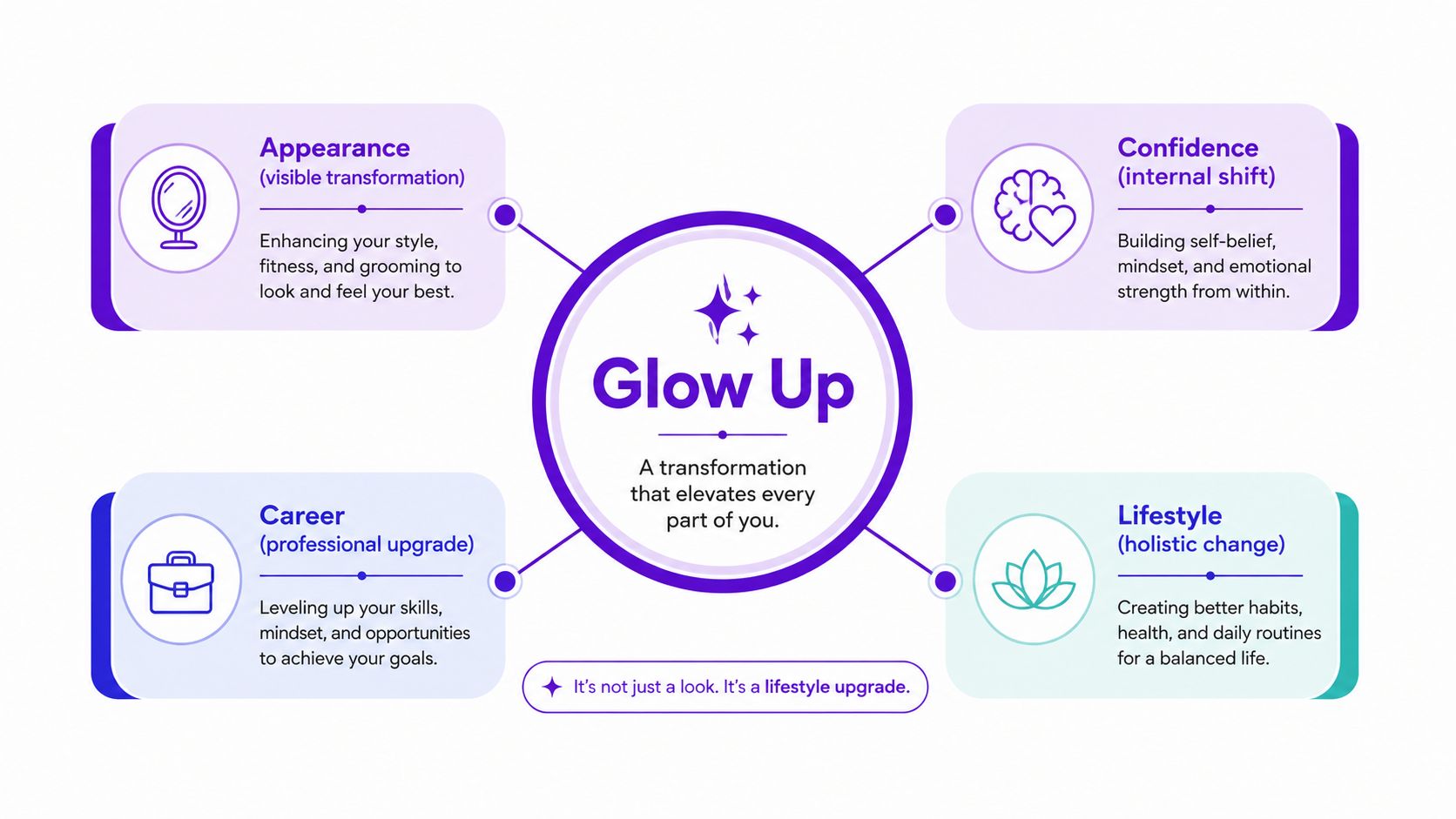
You can think of a glow up as a visual A/B test for self-reinvention. Version A establishes a recognizable starting point. Version B changes selected variables, then presents the result with enough continuity for the viewer to understand that both images belong to the same person or story.
Those variables might include:
A “glow down” reverses the emotional direction by presenting decline, exhaustion, or loss of polish. A “hot-girl walk” is an activity or lifestyle ritual, not necessarily a before-and-after narrative. The defining feature of a glow up is curated proof of growth, often told in two frames.
The beauty details can be personal and practical. If sensitive skin is part of your real-world routine, a resource such as why mandelic acid suits sensitive skin can help you understand a gentler skincare ingredient before turning that routine into visual inspiration. The image may show the result, but the glow up story can include the choices behind it.
“Glow up” emerged in the early 2010s as a wordplay variation on “grow up.” Early usage described broad positive development, including emotional, social, and physical maturity. The phrase carried more than a beauty meaning because growing into greater confidence, wealth, status, or capability could all count as a form of glowing.
Its cultural roots include African American English and hip-hop usage. Merriam-Webster identifies rapper Chief Keef's 2013 song “Gotta Glo Up One Day” as a prominent early example. In that phrase, “glo up” referred not only to appearance, but also to gaining wealth and status. (Merriam-Webster's history of “glow up”)
That broader meaning matters. A creator who posts a new wardrobe may be showing style, but another creator may use the same format to show a new job, stronger boundaries, a more confident posture, or a lifestyle that feels more intentional. The visual reveal is only the surface layer of a larger narrative.
By the latter half of the 2010s, the concept had become a recognizable social-media format. Users posted before-and-after images comparing adolescence with a newer version of themselves. By the late 2010s, online usage commonly connected glow ups with attractiveness, fashion, makeup, skincare, fitness, and cosmetic makeovers.
The shift didn't erase the original meaning. It narrowed the public image of the phrase while preserving its underlying structure: change becomes believable when people can compare two moments. TikTok and Instagram amplified that structure because images, music, captions, and hashtags let creators turn private progress into a shared ritual.
During pandemic lockdowns, TikTok's #coronaglowup surpassed 4.6 million views in 2020, while YouTube's global average daily viewing of videos titled “workout at home” increased by more than 200% after March 15 of that year. (Daily Bruin's reporting on the quarantine glow-up trend) The phrase had become more than slang. It was now a template people could recreate, adapt, and recognize across platforms.
A strong glow-up image usually stacks four ingredients: time, presentation, environment, and aesthetic. You can change all four for a dramatic result, or adjust only one or two for a subtler transformation. Thinking in components makes it easier to reverse-engineer a post you admire without copying the person who made it.
Time provides the narrative. Presentation gives the subject a visible change. Environment establishes context, while aesthetic makes the whole image feel coherent.
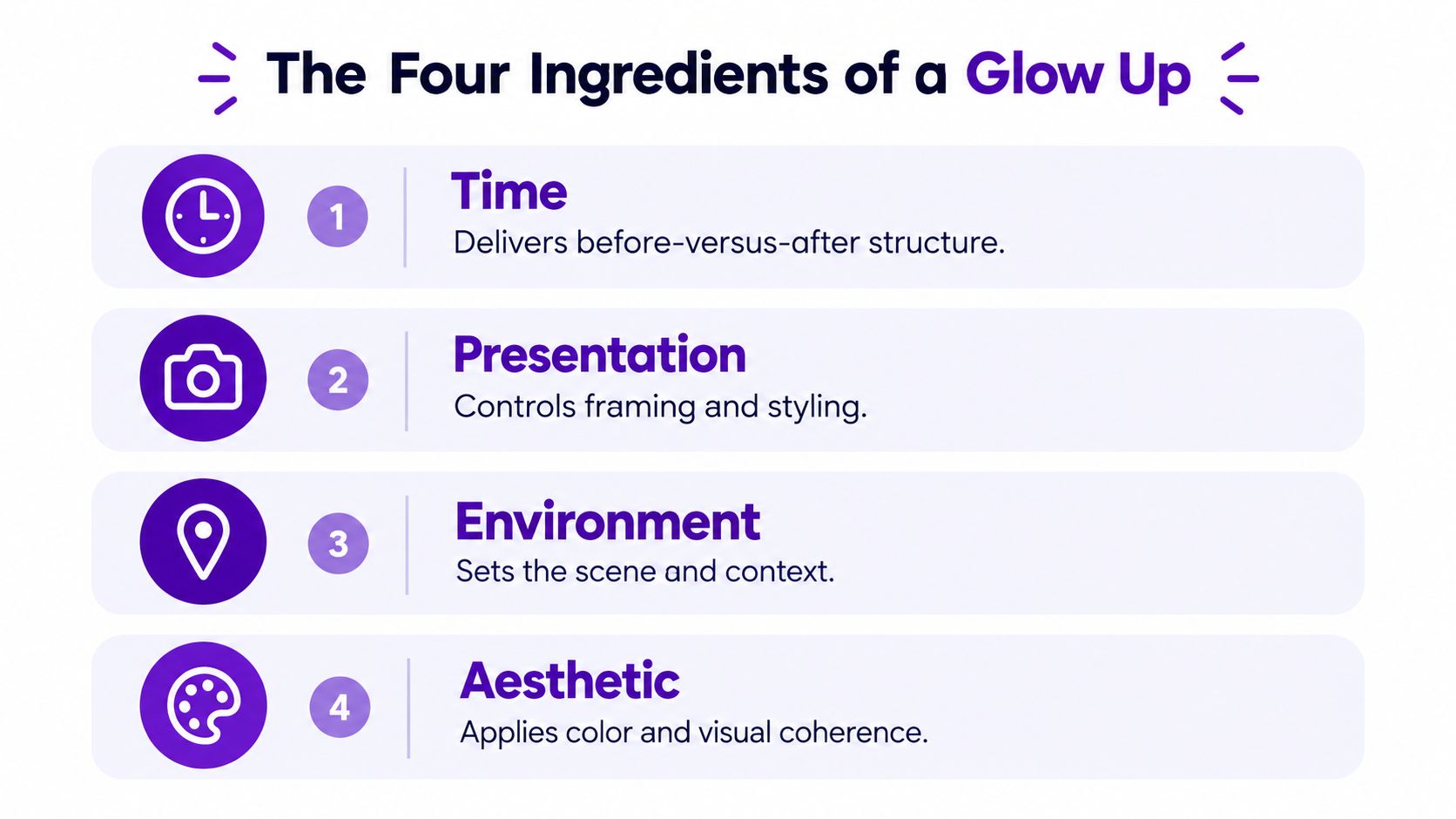
| Ingredient | Content example | Visual role |
|---|---|---|
| Time | Childhood photo beside a current portrait | Creates the before-and-after story |
| Presentation | New haircut, tailored jacket, expressive pose | Shows the chosen transformation |
| Environment | Bedroom mirror replaced by a studio, street, or stage | Adds context and mood |
| Aesthetic | Soft glam, retro film, fantasy, or editorial style | Unifies color, texture, and atmosphere |
Time doesn't have to mean years. It can represent a transition from uncertain to confident, casual to professional, or ordinary to imaginative. The key is that the two frames communicate a meaningful contrast.
Presentation includes controllable choices such as wardrobe, hair, makeup, accessories, framing, expression, and posture. It's often the easiest layer to customize because you can make a dramatic visual difference without changing the person's recognizable features.
Environment tells viewers where this version of the subject belongs. A warm bedroom, neon city, art studio, botanical greenhouse, and futuristic corridor each imply a different identity.
Aesthetic is the final filter of intent. Soft glam suggests polish and warmth. A fantasy direction suggests escape. A character direction suggests narrative. For a deeper look at constructing a clear comparison, explore this guide to before-and-after transformation.
A glow up can feel empowering when it gives you control over presentation. It can feel damaging when the “after” image implies that your unedited face or body was a problem waiting to be corrected.
Research helps explain that difference. In a study of 638 preadolescents aged 9 to 13, more truthful online self-presentation was associated with feeling more positive about appearance, and that relationship became stronger with feedback such as likes, comments, and tags. By contrast, research involving 2,378 Italian preadolescents linked appearance-altering filters and image-mediated interaction with celebrities and influencers to lower body satisfaction. (Research on truthful self-presentation and appearance feedback)
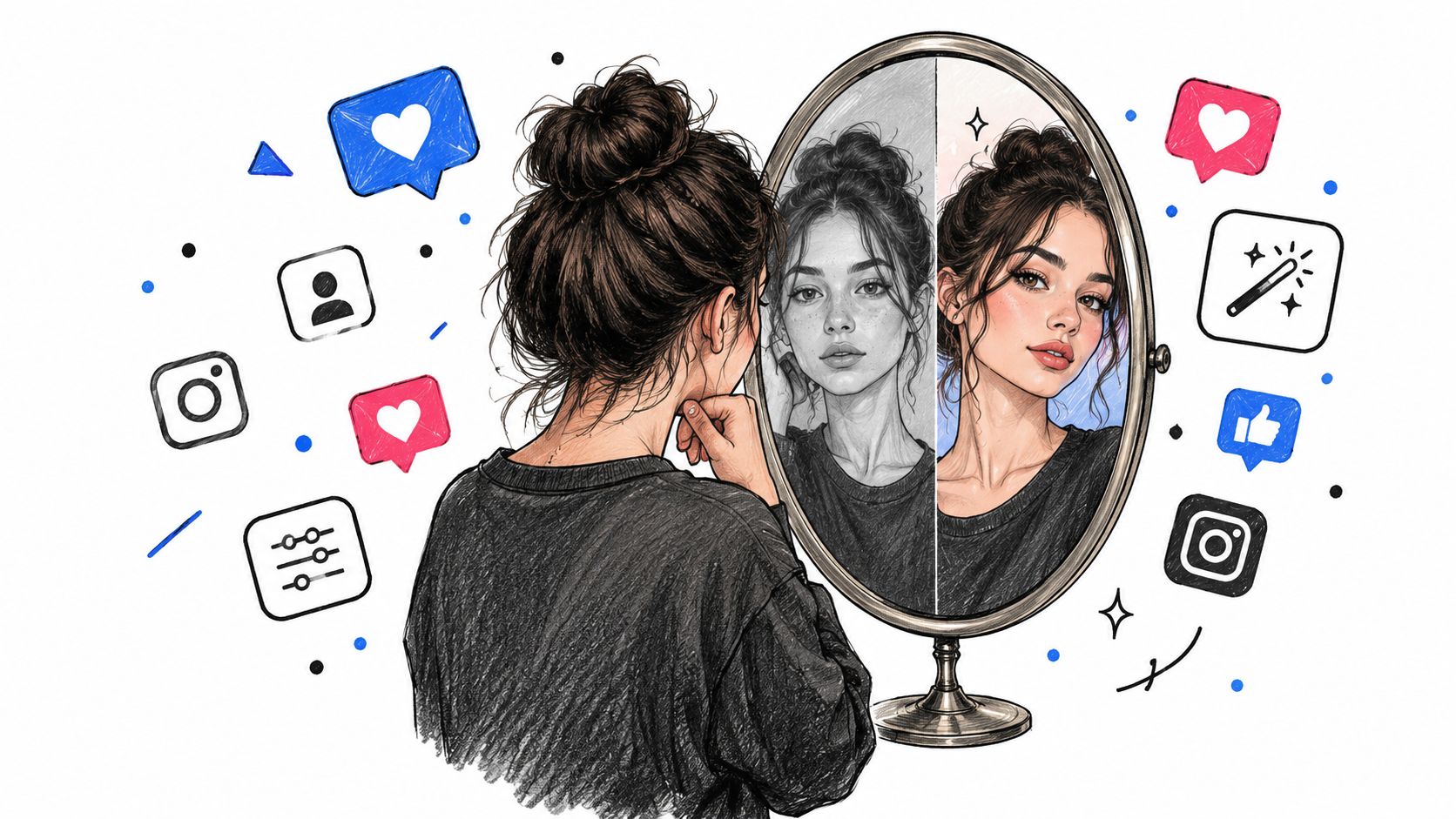
The practical boundary is simple: preserve identity anchors while changing presentation variables. Identity anchors can include facial structure, skin texture variation, cultural styling, age-appropriate proportions, disability markers, or features you want viewers to recognize. Presentation variables include wardrobe, color palette, lighting, setting, pose, and imaginative theme.
A face-slimming filter deserves particular caution. Research summarized by the British Psychological Society found that people who used one compared their real appearance with the edited version more often, preferred the filtered image, experienced worse body image, and showed an 11% increase in anti-fat attitudes among filter users. (British Psychological Society research digest on beauty-filtered selfies)
Before you post, ask: Does this transformation feel like me, or am I chasing a template that doesn't fit? A glow up can be a soft glam portrait, a professional reintroduction, a fantasy avatar, or a more expressive version of your existing style. “More polished” isn't automatically “better,” and a recognizable self can be more compelling than a flawless replacement.
Start with a base photo that gives the transformation something clear to preserve. Choose a well-lit selfie with a visible face, a readable pose, and enough space around the subject for the new environment. If the before image is part of the post, keep its crop and aspect ratio close to the after image so the reveal feels intentional rather than like two unrelated pictures.
A useful prompt names four things:
A starting prompt could read: “Portrait of the same person standing confidently, fitted emerald blazer, subtle jewelry, warm studio lighting, clean editorial fashion photography, natural facial features, recognizable identity, refined color palette.” Specificity gives the generator a clearer creative brief, while identity language helps keep the result connected to the original photo.
Generate a few variations rather than treating the first output as final. Compare the results for facial continuity, clothing clarity, lighting, background, and emotional tone. The strongest image isn't always the most dramatic one. It's the one that makes the before frame feel like the beginning of the same story.
Pair the selected after image with the original photo, using a consistent crop and a clear transition. Match the new image's mood to your existing feed. A quiet minimalist account may benefit from clean styling and restrained color, while a fantasy creator can lean into stars, unusual architecture, or costume.
If your glow up includes a real skincare or grooming routine, keep the practical process separate from the AI image. A clear affordable skincare routine guide can help you think through product order and consistency, while starryai handles the visual concept. Caption the result as experimentation, styling, or a new visual identity, not as proof that one version of your face has greater worth.
The fastest way past creative indecision is to choose the emotional read first. Do you want the image to feel calm, glamorous, otherworldly, nostalgic, or narrative? Once you know that, the prompt can describe the visual choices that support it.
| Direction | Mood | Starter prompt |
|---|---|---|
| Minimalist | Clean, composed, quietly confident | “Natural features, crisp white shirt, soft daylight, neutral background, refined editorial portrait” |
| Soft glam | Warm, polished, romantic | “Fresh luminous makeup, flowing satin outfit, warm peach lighting, elegant beauty editorial” |
| Fantasy | Escapist, magical, expansive | “Recognizable person in a moonlit garden, silver details, floating stars, cinematic fantasy atmosphere” |
| Era jump | Nostalgic, referential, styled | “Same person reimagined in a 1970s-inspired outfit, vintage film grain, warm analog colors” |
| Character | Story-driven, memorable, role-based | “Confident space captain, structured uniform, futuristic command deck, cinematic character portrait” |
Minimalist works when you want the transformation to come from restraint. Change the lighting, tailoring, posture, and background while keeping the subject close to everyday reality.
Soft glam emphasizes beauty presentation without requiring an entirely new identity. Use makeup, fabric, jewelry, and flattering light, then preserve distinctive features so the image still feels personal.
Fantasy and character directions give you more room to experiment. They suit gamers, tabletop role-playing creators, indie authors, and anyone who wants the glow up to introduce a role rather than claim a real-life physical change.
Era-based transformations need cultural awareness. A 2025 study of filtered-image recognition found that people identified edits more quickly and accurately when bodies matched historically dominant ideals, including thin female bodies and muscular male bodies. (PubMed research on filtered-image recognition and beauty ideals) If an image changes skin tone, body proportions, facial structure, or culturally significant features, use a transparent caption. You can also name the inspiration, explain the fictional intent, and avoid presenting one aesthetic as a universal destination.
For a platform-specific version of this creative exercise, use the TikTok glow-up transformation guide as a starting point, then adjust the direction to fit your own voice.
A successful post should leave room for curiosity, not pressure. Before publishing, check whether the image celebrates a choice you made or quietly repeats a standard you never chose.
Use this checklist:
These choices also help creators avoid turning engagement into a constant appearance test. A review of 58 empirical studies published from 2014 through 2026 found recurring links between appearance-focused engagement and body dissatisfaction, body surveillance, drive for thinness, and negative affect. The review identified appearance comparison, internalization of appearance ideals, and self-objectification as recurring mechanisms. (Review of appearance-focused social-media engagement)
That doesn't mean every glow-up post causes harm. It means context matters. A transformation framed as “I'm trying a cinematic era” communicates something different from “I fixed everything wrong with my face.”
starryai is a free option for experimenting with selfies, text prompts, emojis, styles, and imaginative transformations. Use it as a creative playground, not a scorecard. If you want to control how your finished image reaches an audience, review the available sharing options before you publish.
starryai lets you turn a selfie or text idea into a visual identity experiment, from minimalist styling to fantasy character design. Visit starryai and create a before-and-after glow up that shows where your imagination is going, not what you think your real appearance needs to become.


.svg)