

Written by Mo Kahn on


You open a group chat and two friends have swapped their photos for matching anime portraits, same line weight, same sunset behind them. A little later a TikTok shows a couple selfie redrawn as a festival scene, and the comments are people tagging partners. That is the pull of anime couple photos. They are small, but they carry a relationship, a fandom, and a look in one frame.
A solo portrait says who someone is. A pair says who they are together, which is why these images travel farther in chats, stories, and comment threads. The method below is the one that holds up after dozens of generations: pick a source, decide what the relationship should communicate, write a prompt that steers the generator, style the pair so they read as one image, then fix the usual failures before you post.
A friend's story lands with two matching anime avatars, same hair highlights, same jacket colors, posted side by side. A ship edit under a trending sound pulls comments from people who have never met. Those posts work because they compress three things at once: a relationship, a fandom allegiance, and an aesthetic.
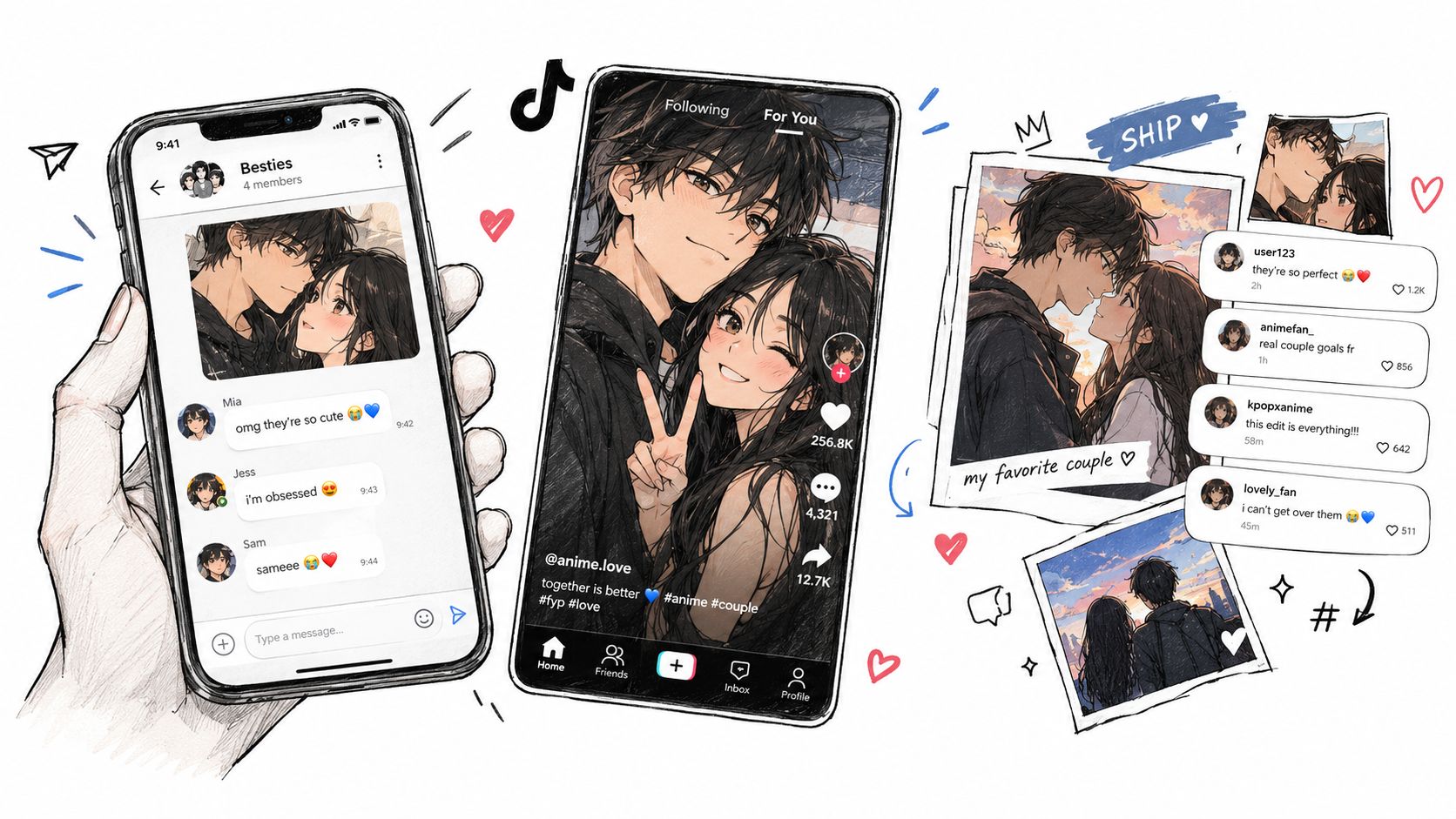
A single face is a costume. Two characters together are a story someone can react to, tag a friend in, or claim as their ship. That is why paired portraits tend to outperform solo ones for this kind of sharing, even when the drawing quality is similar.
The 2025 Global State of Anime study surveyed 29,000 general-entertainment consumers aged 13–54, including 3,500 anime fans, across the United States, United Kingdom, India, Germany, France, Brazil, and Mexico. It found that 40% of anime fans discover new series partly through fan edits on TikTok and Instagram, 42% watch anime with other people in person, and two in five have made friends online through anime. The same research reported that 48% of anime fans had experienced a crush on an anime character. Discovery, shared viewing, and emotional attachment are why couple formats travel.
You will choose or upload source images, plan a pose that signals a specific relationship, write prompts that steer the generator, style the pair so the colors agree, fix the failures that show up in almost every first batch, and share the result without stepping on consent or someone else's rights.
By the end you will have a repeatable way to make an anime couple photo that says something specific about the two people in it, not a generic cute pair that could belong to anyone.
Two paths get you to a usable pair, and they fail for different reasons. Transforming a real selfie keeps likeness. Generating from text alone gives you original characters you can sell or print. Pick the path before you open a generator, because a muddy source photo wastes more time than a weak prompt.
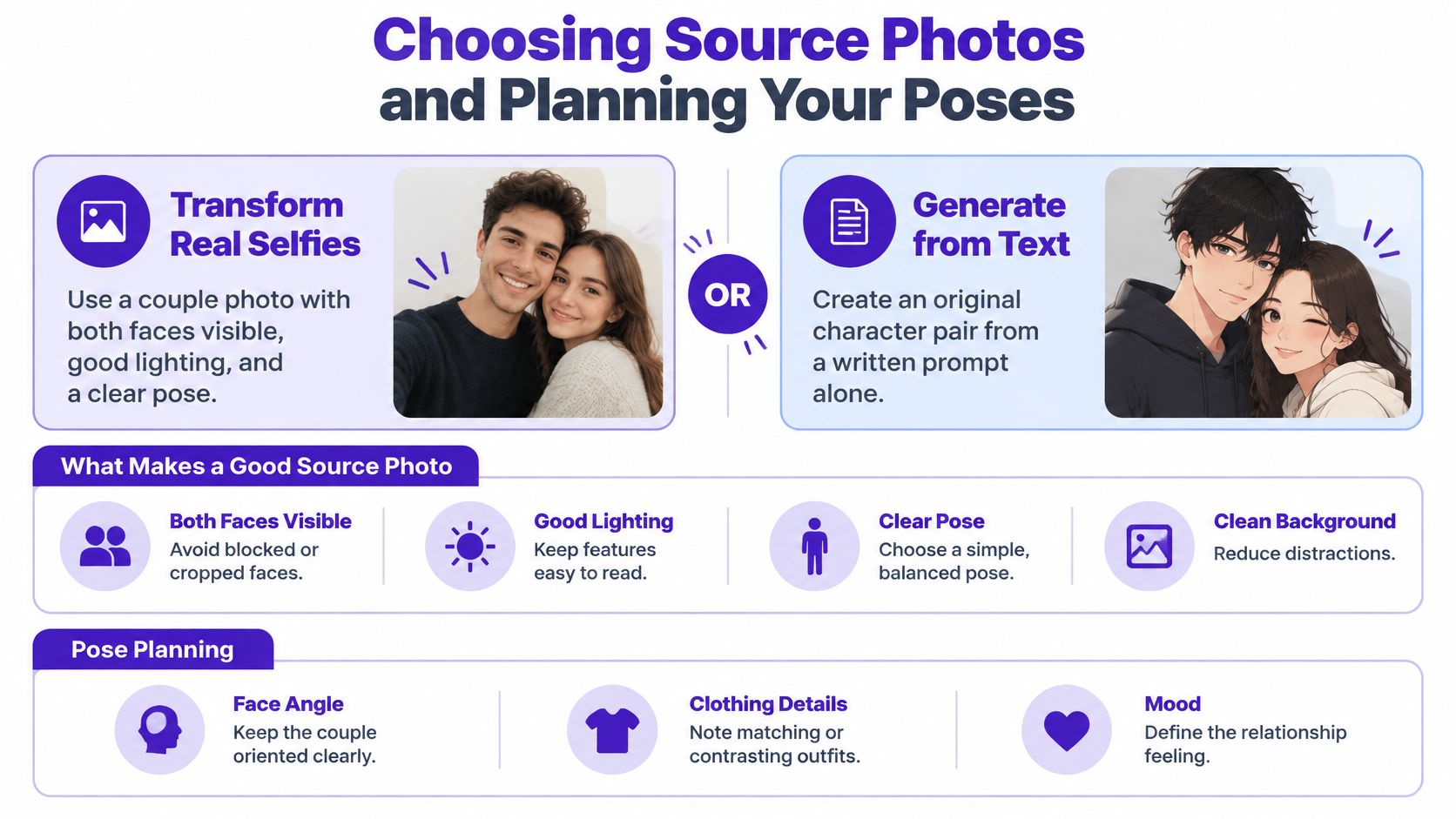
Both faces visible: Sunglasses, hands over a cheek, and heavy crops are the usual reason one person comes back unrecognizable. If you want a closer look at photo-to-anime conversion, this walkthrough on turning photos into anime covers what the model can and cannot recover from a reference.
Even light: A window on one side and a dark room on the other makes the generator invent features. Soft, even light on both faces beats a dramatic selfie every time.
A pose the model can read: Front or three-quarter views, shoulders apart, hands not covering the torso. Profile shots and overlapping bodies are where hands merge and faces drift.
A quiet background: A busy street, a mirror selfie with phones, or a crowd behind you fights the composition. A plain wall or open sky leaves room for the scene you will describe later.
For a text-only pair, sketch both people in words before you prompt. Give each a role, a hair silhouette, a clothing color, and one gesture. "Two original characters, one with a short black bob and a warm red jacket, one with long silver hair and a cool blue coat, standing close at a night market" beats "cute anime couple" because the model has contrast to draw.
Eye contact and a slight lean read as intimacy. Back-to-back stances read as rivals or partners in a fight. A wide gap between shoulders reads as friendship or tension, not romance. Audiences already know this language. By August 2021, Instagram held more than 51.6 million posts tagged #cosplay, including about 7.1 million tagged #cosplaygirl and 403,000 tagged #cosplayboy, according to a 2024 academic discussion of digital cosplay. That source also cites a 2015 Eventbrite survey in which about 64% of cosplayers were women, 60% were between 23 and 39, and 29% named anime or manga as their main fan interest. Between 2016 and 2019, Twitter recorded a 233% rise in expressions of fandom and a 332% rise in uses of "stanning." Coordinated costumes and side-by-side poses are a fluent visual dialect, not a niche trick.
Before you generate, run a short check: both faces readable, one clear pose, a named relationship, and a background that will not compete.
A prompt that starts with the relationship beats one that starts with "cute." Anime fandom treats pairings as interpretive rather than fixed, and communities often support more than one ship for the same character, as discussions of fan-preferred couples make obvious. A 2025 survey report found that 39% of anime fans identify as LGBTQIA+, so a default heterosexual-romance frame leaves a large audience out. Name the dynamic first.
Use five slots, in this order: relationship dynamic, scene, wardrobe, mood and lighting, framing. If you want a fuller primer on slot order, this guide to how to write AI prompts is worth a pass before you lock a template. The same habit of naming a motif before style shows up in visual work outside portraits. People planning plan a Japanese tattoo sleeve get cleaner results when the story comes before the ornament, and couple prompts behave the same way.
Romantic, quiet domestic intimacy: "Two original characters sharing quiet domestic intimacy in a small kitchen at dusk, one in a warm ochre cardigan, one in a cool slate shirt, soft window light, medium shot, clear dark outlines, anime style, no text."
Platonic, best friends at a festival: "Two original characters as best friends at a summer festival, laughing with a paper lantern between them, one in a coral yukata, one in a teal hoodie over festival wear, warm string lights, three-quarter view, anime style, no text."
Ambiguous, rivals protecting each other: "Two original characters, rivals protecting each other on a rainy rooftop, back to back, one in a warm crimson coat, one in a cool indigo jacket, neon reflections, low angle, sharp outlines, anime style, no text."
Small wording shifts change the read. Swap "laughing" for "holding hands" and the festival prompt turns tender. Swap "back to back" for "facing each other, a step apart" and the rooftop prompt turns into a standoff instead of a partnership.
| Prompt Element | Example Phrase | What It Controls |
|---|---|---|
| Relationship dynamic | quiet domestic intimacy | Emotional story, not just "couple" |
| Scene | small kitchen at dusk | Setting and time of day |
| Wardrobe | ochre cardigan, slate shirt | Color split and personality |
| Mood and lighting | soft window light | Warmth, contrast, focal glow |
| Framing | medium shot, clear dark outlines | Crop, line weight, style unity |
Skip living-artist names and franchise character names. Describe original traits, or the output drifts toward a design you do not own.
Treat the pair as one visual system. Research on anime visual design points to clear borders, sparse color blocks, high saturation, concentrated light-dark regions, and abrupt color transitions as the style's signature. Character studies in that same line of work treat clothing, hair, eyes, expressions, and backstory as joint signals of personality. An avatar color-harmony study in that research tested 236 paired images and found split-complementary red especially preferred, while blue-based harmonies were broadly well received.
Give one character a warm dominant family and the other a cool one. Reserve the single highest-saturation accent for the emotional focal point: joined hands, eye highlights, a shared scarf. If both costumes shout at the same volume, hierarchy collapses and the couple looks disconnected even when they are standing close.
Keep outline color and thickness matched. Outline treatment changes impressions of naturalness, potency, and activity, so a heavy black line on one figure and a pale line on the other reads as two different shows pasted together.
Generate at least three variants and judge them small.
Analogous: Neighboring hues, useful for tenderness and domestic scenes. It can go muddy if both outfits sit in the same value.
Complementary: Opposite hues, useful for rivals and high-energy scenes. It fails when both accents are fully saturated.
Split-complementary: One lead hue plus the two neighbors of its opposite. This is the set worth testing first when you want a red accent without a full red-versus-green fight.
Shrink each variant to thumbnail size, then check a grayscale copy. If the pair still separates in gray, the value structure is doing its job. If they merge, the color was doing all the work and the image will fall apart on a phone.
Golden hour flatters romance and anniversaries. Neon and hard rim light suit rivals and night markets. Soft overcast suits friendship and quiet closeness. Eye styling follows the same rule as color: one focal point, not two competing ones. If you are pushing lash shape and highlight placement, Bonna Beauty's anime lash guide is a useful reference for how exaggerated lashes change a face, so you do not give both characters identical stage-makeup eyes unless that is the joke.
Open starryai's anime image generator and start from the path you already chose. Upload the couple selfie if likeness matters, or leave the canvas blank and paste a five-slot prompt if you want original characters.
Select an anime art style, paste the structured prompt, and generate a small batch. starryai is a free AI image generator that turns text and uploaded photos into anime-style images, so three or four rounds are a normal pass, not a sign the prompt failed.
Faces first: Check whether both people still look like themselves, or like the two originals you described. A pretty image with a swapped jawline is a miss.
Hands second: Count fingers and see whether arms connect to the right shoulders. Merged hands are the most common reason to reject an otherwise strong frame.
Palette third: Confirm the warm lead and the cool lead still separate, and that only one accent is screaming.
Background last: If signage, crowds, or random furniture pull your eye off the pair, the scene description was too vague or the source photo was too busy.
Pick the strongest candidate instead of regenerating the whole set. Blind rerolls throw away a good pose because one hand was wrong.
On an uploaded photo, the Edit tool is the faster fix. Restyle one outfit, clean the background, or nudge the line work toward the anime look you want without rebuilding the faces. If you are comparing editors and care who stores the selfie, it helps to find privacy-focused AI photo editors and read how each one handles uploads before you drop personal photos into a workflow.
A short demo of the generate-and-refine loop is easier to follow than a second written pass.
Save the winning prompt in your notes, including the style name and the relationship slot. Tomorrow's variation should change one slot, not all five, or you will not know which words worked.
Most bad batches fail in the same five ways. Fix the cause, then decide whether the image is even allowed to leave your phone.
One face sharp, the other melted: The source photo hid that face, or the prompt described only one person in detail. Re-upload a clearer reference, or add a second sentence that names hair, face shape, and expression for the weaker character.
Hands merging or multiplying: The pose had overlapping fingers. Switch to a simpler gesture, "hands at sides" or "one shared scarf," and use Edit to repaint the remaining hand rather than regenerating the faces.
Two different art styles: Outline weight or saturation drifted between the figures. Add "matching line weight, same anime style on both characters" and reject any output where one figure looks painted and the other looks cel-shaded.
Palette competition: Both costumes are fully saturated. Drop one accent, keep the warm-cool split, and check the thumbnail again.
Background stealing focus: Name a simple setting and a shallow sense of depth, "plain evening sky, couple in the foreground." Edit can also knock the background down without touching the faces.
An attractive image can still be the wrong image to post or sell. Creators turning real selfies into anime art should get consent from both people, avoid prompts that reproduce protected characters or a living artist's style, and check marketplace rules before selling, a point that recent coverage of shared couple transformations never really answers for Etsy sellers, indie authors, and social managers.
Under Japanese copyright law, fan works that use established characters can implicate the reproduction right in Article 21, the adaptation right in Article 27, and, once you distribute them, the right to exploit a derivative work in Article 28, as discussed in research on fan works and Japanese copyright. Japan uses a closed list of exceptions, not a broad fair-use doctrine, so noncommercial intent does not make a copy lawful by itself.
Tolerance is not the same as permission. The Agency for Cultural Affairs has described derivative activities such as doujinshi as less likely to draw intervention when they do not compete with the original, do not unfairly harm the rights holder, and do not copy the work, a distinction explained in a note on how Japan treats fan creations. Rights holders step in when a fan work gets commercially large, hurts a brand, or breaks posted guidelines.
Property rules can be numerical. Nitroplus, a Japanese character-design agency, limited certain derivative works to 200 pieces and expected sales of no more than 100,000 yen, with different criteria for doujinshi, as reported by Anime News Network's feature on derivative content. If you are posting for fun, keep it original and get consent. If you are selling prints, assume you need original characters, your own prompt records, and a pass through the marketplace's rules.
The whole method fits in five lines.
Pick the source. A clear selfie of both of you, or a blank prompt for original characters.
Name the dynamic. Romantic, platonic, rival, or ambiguous, before you touch style.
Write the five slots. Relationship, scene, wardrobe, mood, framing.
Style the pair. One warm lead, one cool lead, one accent, matched outlines.
Fix, then share. Faces and hands first, consent and originality before anyone else sees it.
Decide what the image should say about the relationship before you touch style or color. Lucky outputs fade. A chosen dynamic is what you can repeat.
You can finish the first pass in about ten minutes. Open starryai, upload a favorite selfie or start from the festival prompt above, and generate three variants tonight. Keep the one where the relationship is obvious at thumbnail size, save that prompt, and leave the rest.
starryai turns selfies and text prompts into anime-style images you can refine in a few quick passes, which is exactly the loop this guide uses for anime couple photos. If you want the first three variants on your phone tonight, start with a clear photo or a five-slot prompt. Visit starryai and generate the pair before you tweak a single color.


